
8-minute read - Names have been changed for privacy.
Somewhere in your own organization, there's probably a leader only using one hand. Jason was. Here's how he found the other one.

Jason is an inside sales leader at a commercial equipment business. He's smart, direct, and able to take responsibility when something needs to get done. All of these qualities have served him well and he has been moving forward in his career.
He was also a self-proclaimed "hothead" who would "just go knock the door down." He even had a saying for it, "fear before respect." But as he put it, "Not fear, as in you're scared of me, but he's gonna be here tomorrow if I don't have answers."
When Jason and I met several years ago, our relationship began with the usual conversations about projects, co-workers and customers. Over time, we expanded into more developmental topics like leadership, communication, and understanding of how people come to see things so differently.
What I love is what Jason started doing with those conversations. He was recognizing his own reactions and becoming curious. He would listen a little longer, and consider how the situations might look to the other people involved. He was still direct and expected people to follow through, but he was finding more ways to work with them.
As he applied what he was finding, his working relationships began changing. He was becoming someone people wanted to learn from and have involved.
Because Jason has grown so much, I wanted to hear from him what had changed. We sat down together to recap the last few years.
Understanding Before Action
Being direct and quick to address problems was Jason's default, and listening wasn't his strong suit. In our past conversations we talked a lot about communication and understanding people, and he started to notice how often his assumptions were shaping his conversations.
Jason admitted, "A lot of times I'm just waiting for the person to stop talking because I already know what they're saying…it's hard to be a good listener."
An experience he shared about an employee named Tyler gave me a good example of how he was applying what he'd learned.
Tyler had been struggling at work. He was missing days and his work was slipping. Jason could tell something was off, so he took Tyler aside and asked, "I noticed you're not doing well. How can I help you?"
As he listened, Jason found out Tyler was going through a tough time in his personal life. It was something no one at work knew about. While others assumed Tyler might not be qualified for the position he was in, the private conversation helped Jason understand what was really going on.
Jason himself knew personal struggles all too well. He related to Tyler by saying, "Hey, I know this is hard because as you know, I was going through a time where…"
Jason invited Tyler to work with him for a while. He made the expectations clear, including when Tyler needed to be at work and what responsibilities he needed to handle. He also made sure Tyler knew he would have support.
What Jason did unknowingly, but beautifully, was something I learned from the psychiatrist and neuroscientist Bruce Perry: regulate, relate, and reason.
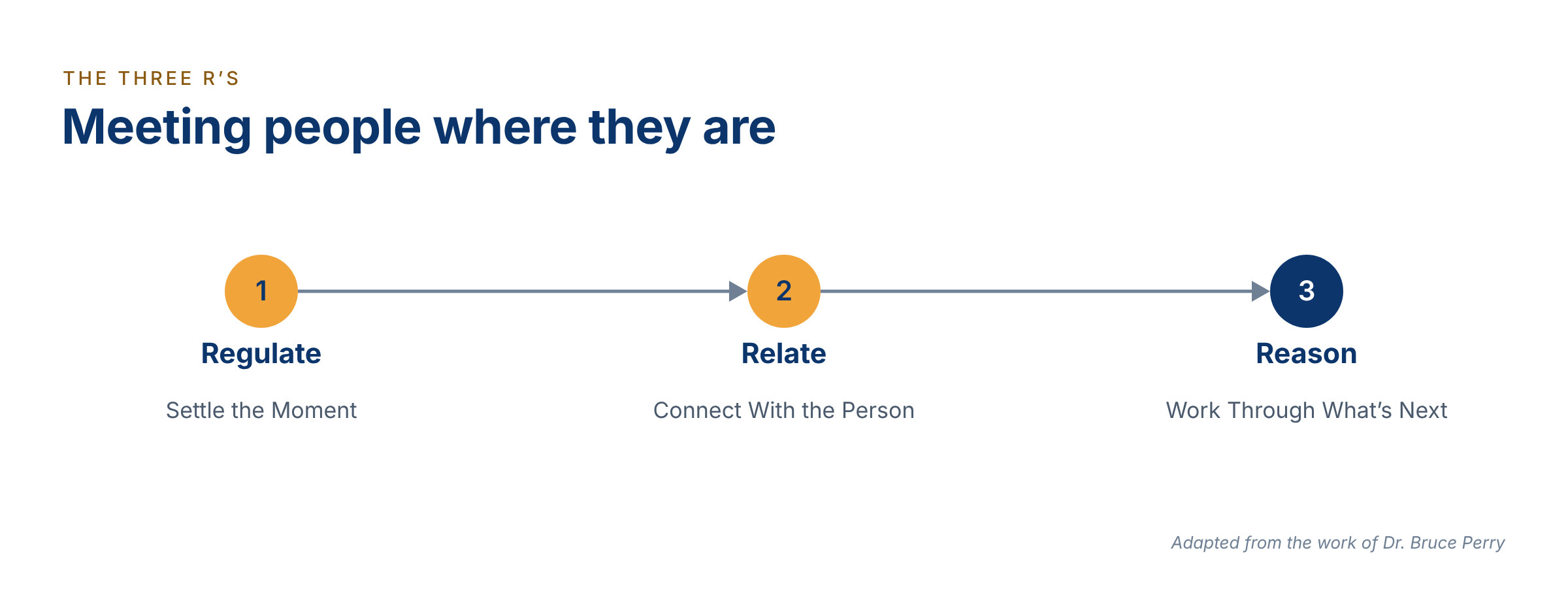
By developing the skills to notice his own reactions and be curious about the other person, Jason was able to do this naturally:
Regulate: Jason took Tyler aside, out of the normal work environment.
Relate: "Hey, I know this is hard because as you know, I was going through a time where…"
Reason: "Come work with me, I wanna show you things."
Jason met Tyler where he was at and provided a way for Tyler to succeed, and according to Jason, he's "doing really well." Taking an interest in Tyler allowed Jason to approach the situation with a better understanding of the actual person involved, while still maintaining expectations and accountability.
Carrots for the Mind
Something Jason began noticing over the last few years was the value of finding his own answers. When talking about our conversations, he said, "You wanted to teach and not just give the answer, which I really liked…it made me better at my job…you were doing it to make me better. I could tell that's what it was."
By hearing Jason out, I was able to choose how to present just enough of a new concept for him to chew on. It was like dangling a carrot for his mind to chase, and he would take it from there.
“...sit in the car and be like, wait, that kind of makes sense.”
I laughed when he said there were times when I would suggest something new and, in the moment, he would think to himself, "that's dumb." But later he would "sit in the car and be like, wait, that kind of makes sense."
There's more scientific backing on this approach than most people think. It's called generative learning and I've used it regularly throughout my career.
Researchers Logan Fiorella and Richard Mayer showed how people develop a deeper understanding and retention by actively connecting new information with what they already know.
Here is an example of how this would apply in a sales leader's world:
A salesperson asks: "How should I do this?"
Sales Manager A (direct response): "I would start with the decision-maker, lead with the budget question, and send the quote."
Can this work? Yes.
Can it be done more effectively? Also, yes.
Sales Manager B (generative response): "What part are you unsure of? Walk me through how you would work through it, and I'll help you dial it in."
Sales Manager B engages what the salesperson already knows. Once the manager knows what's there, they're able to give specific prompts, or dangle carrots, for the salesperson to come up with a solution on their own.
I used the generative learning approach for stronger retention with my students when teaching at the college. One student wrote on an anonymous instructor survey, “Matt makes my brain stretch until I figure it out.”
More than twenty years later, I ran into a former student, who I hadn't seen since he'd graduated. When we saw each other across the room, his face lit up, and instead of saying hello, he pointed right at me and shouted the definition for a vocabulary word we had used in his second year of the four-year program. We burst out laughing.
Again, like the regulate, relate and reason example from above, Jason didn't know he was practicing generative learning, but he certainly was. He described how exciting it was and how he put it into action with his own team.
"I can help these guys get their own answer," he said, "by doing just what you would do with me."
Trust
One of the things I appreciated most during our recap was how openly Jason talked about trust.
"There was no fakeness. I could be me and you took me for me. And so that was really important. Because I have to drop a guard to say, yeah, I'm not as good at this. And in order to do that, I have to feel comfortable with you."
He told me it was the little things like not checking my phone and being "totally focused on the time we had together."
Consistency was important, too. Jason noticed I could meet with him, "the hothead," and then turn to the president of the company and be completely formal, without changing who I was as a person.
Jason was skeptical when I suggested being more open, and we saw it work with Tyler. Jason told me: "I really had to trust you on this…being a little more open with people, they grab onto that."
The trust went in several directions. Jason told me about the patience it took to gain trust with the leaders above him. Now Jason, the same guy who used to "just go knock the door down," gets asked to come into rooms, and other leaders come to him asking, "how would you approach this person?"
He says, "They call me the farm now and they're going to feed their interns through me."
One of my favorite comments was when he put his right arm behind his back and said, "It's like I've only been using my left hand this whole time!"
All of this points to Jason finding trust in himself, and his confidence showed through the whole time we spent doing our recap.
“Somewhere in your own organization, there’s probably a leader only using one hand.”
More Ways to Lead
Toward the end, I told Jason how proud I was of all the work he has done and continues to do. Some of the skills he has developed take others a lifetime to learn.
He is recognizing himself and what he is bringing to each moment. He is actively listening, and allowing his perception to be flexible. He is providing opportunities for other people to grow, not just managing.
He said, "I wouldn't have done this. You showed me this."
Jason gives me a lot of credit in that comment, but he's the one who did all the work.
I just knew what carrots to dangle.
I’d like to hear about your teams.
When can you make time to talk?
Matt Butler, MB Resources | 801.244.4844 | matt@mattbutler.org
Matt has spent 35 years in the mechanical trades, in the field as a technician, in the classroom as a college instructor, and in wholesale distribution. After 15 years as a manufacturers' rep and co-owner of an independent rep agency, leading a high-performing territory, he started MB Resources to coach sales leaders and their teams in distribution and manufacturing.
Learn more at mattbutler.org.